
Written and drawn, in your voice
I write and illustrate for small businesses and organizations — newsletters, annual reports, donor and member letters, catalog and web copy, single commissioned pieces. Everything verified for accuracy, everything drawn by hand.
The standing arrangement is the newsletter: two finished pieces a month, each with an original hand-drawn illustration, publish-ready. A good newsletter keeps your best clients and customers coming back. Most go quiet for one reason: writing them well takes hours no one has. I take the work over completely. You spend 20 minutes a month answering questions by email. I deliver both pieces, written in your voice, laid out in your platform, ready to send.
This is an example of one piece, on my own subject. Yours would be in your voice, about your work.
Peek Inside the Pot
More than 10 years ago I was shopping for perennials at a late-season clearance at Village Nursery and spied a dead-looking lavender clematis. There was more trellis than actual plant sticking up.
That's my weakness, finding the perennials that scream "toss me in the compost pile" instead of "I'm alive." I bought this one because it was heavier than it looked, and still green at the crown.
Almost everything worth knowing about a plant in a pot is below the rim, not on the tag. So give the parts of the plant inside the pot a thorough once over.
Start at the surface. Weeds or moss growing on the soil indicate the plant has been sitting a long while, in that pot, in that spot. That's not automatically a reason to walk away. The longer it's been there, the more chances something has had to find it — insects, fungus, root rot, or plain neglect.
Then pick it up. This is the part people skip. A pot should have some weight to it, the weight of a rootball holding water. Bone dry and light means the roots have been through a drought inside that pot, probably more than once.
My clematis was just right. The soil wasn't dried out, and it wasn't wet with moss growing on top. It still had some weight to its body when I picked it up.
Then look at what's green. Small but sturdy green shoots were pushing up from the surface of the soil, new growth coming from the crown, which is where a clematis starts over. Under the dried-up mop hovering above, two or three vines were still green and solid.
I talk to them at this point. How's this one doing? Do you need anything?
Now turn the pot over and look at the bottom. Roots coming out the drainage holes in a mass means the plant has outgrown its container and will need to be transplanted.
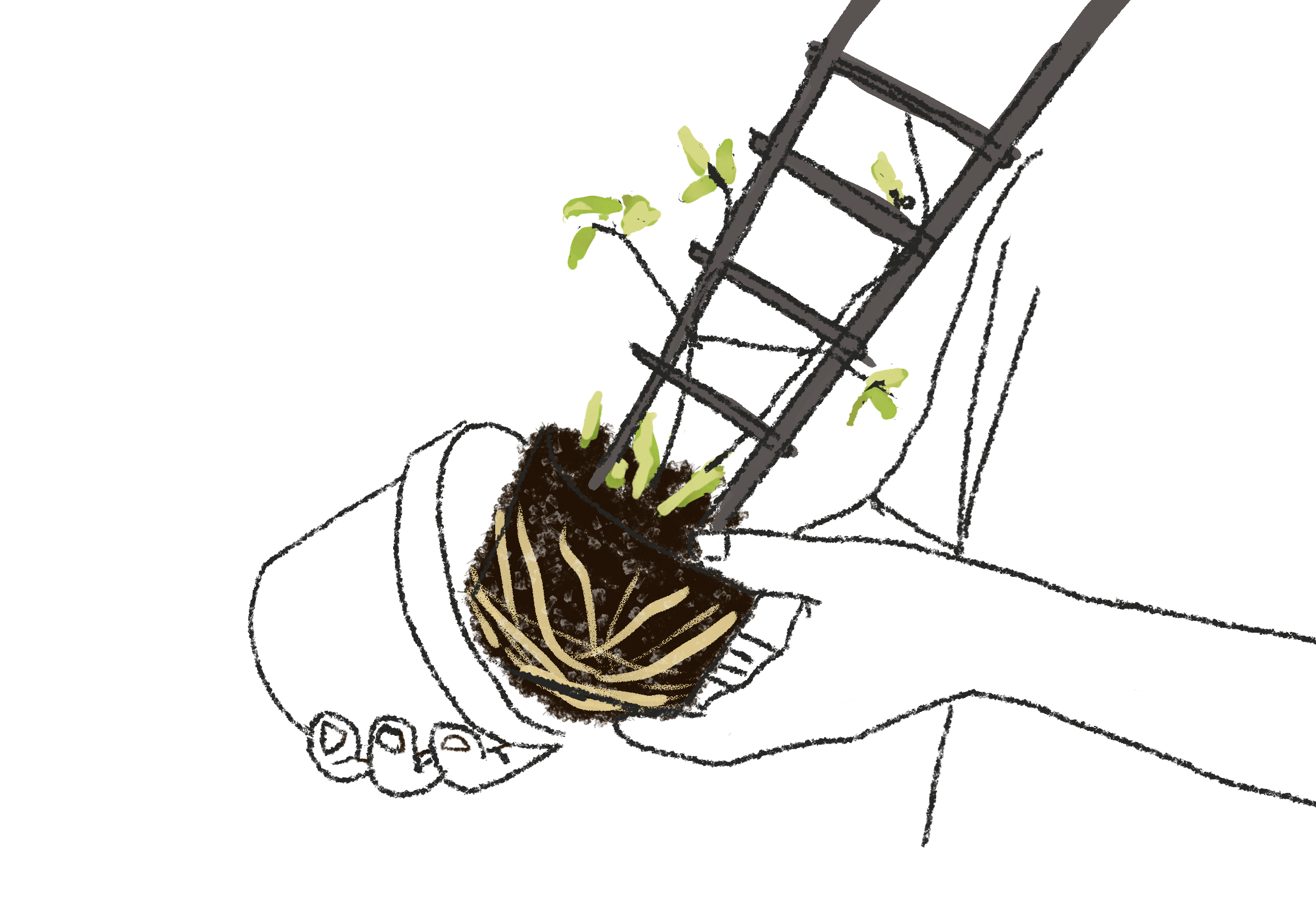
Then slide the rootball out. Tip the pot, put one hand under the base, and let the whole thing come out.
Roots should be firm and pale, and they should feel like roots. Stringy, brown, or soft means rot. Wound tight in circles around the outside of the ball means the plant has been in that pot too long. Loose and spreading is what you want.
These roots were just right. Miraculously, this perennial appeared to have been well cared for. Or, it might have gotten lucky with the weather. It had been outside, not in a greenhouse where it would have had to rely on humans taking care of thousands of other plants.
The clematis was marked down to $5. A good clematis costs around $25 or $35 today. The owner looked at me and my pile of sad-looking clearance plants, frowned at the clematis, and said, "I can't charge you for that." We bartered. He gave it to me.
It went into a client's bed, in the perfect spot to climb to the outdoor deck above.
"Don't look at it. (It looked pitiful.) Don't worry. I didn't have to pay anything for it. Just trust me."
She did.
I planted it just as I would the most beautiful fresh gallon-size perennial, and gave it a soaking once a day for a week. Then summer turned to fall, then winter, and enough snow fell to insulate it in place.
Clematis can be slow to show itself in a New England spring. You have to look hard to find your plants, and then keep looking, because the first growth is thin and low and easy to pull out along with the weeds. Once you do, give them shade in front of the base (a rock works well), a good soak as needed, and then leave them alone.
That free clematis bloomed in the spring. Even better, it's still blooming anew each spring more than a decade later.
A different clematis, mail-ordered from a fancy nursery, looked great at first, but it never found happiness in its new home. It stopped returning after only a few years.
The standard
I was a research editor before anything else. Facts in your pieces are verified against sources before your readers see them. The illustrations are drawn by hand, from observation — no stock images, nothing machine-generated. In inboxes filling with automated content, work made by a person stands out immediately, and it reflects on the organization that sends it.
The newsletter arrangement — each month
Two pieces, 600 to 900 words each, in your voice. An original hand-drawn illustration with each. One revision round on each. Final files laid out in your platform, ready to send. An editorial plan, so you know what's coming. One 20-minute intake by email — no meetings, no calls necessary.
Terms
The fee my service replaces a writer, an illustrator, and an editor — and the monthly hours of whomever would be assigned to do this.
From $2,500 per month. Three-month minimum, then month to month. Three months because one piece proves nothing; it's long enough to see it work. Not included: list-building, advertising, social media, or platform setup. Your audience remains yours.
Project work
Anything outside the monthly arrangement — an annual report, a season's catalog copy, one commissioned piece — is quoted per project.
Who writes it
I'm Linda Pilgrim — editor, writer, and illustrator in New England. Decades of professional work writing in other people's voices, verifying claims as a research editor, and drawing from life. I take a few clients at a time. My own written-and-illustrated publication is Harticulturalish — the standing sample of both crafts.
See the work before you commit
Considering the monthly arrangement? I'll write and illustrate one complete sample piece on a subject you choose, at no charge, so you see your voice on the page before you decide. I take two samples at a time, so each gets my full attention. If both slots are full, I'll tell you when one opens. For project work, I quote directly; my published pieces are the sample.
You see your own voice on the page, finished, before any decision. Tell me about your organization below; I will reply within two business days with a few short questions, then deliver the piece. Everything runs by email. If the sample is right, we set terms and begin with a three-month engagement.
Questions
Already sending a newsletter?
You keep your list and your platform; I take over the writing and add the illustration.
Need more than two pieces?
Additional pieces are priced per piece.
Who owns the work?
You own the writing in full. Illustrations are licensed to your newsletter and website; originals remain mine.